 |
Wireshark 5.1.0
The Wireshark network protocol analyzer
|
Loading...
Searching...
No Matches
|
Wireshark 5.1.0
The Wireshark network protocol analyzer
|
#include <system_theme_detector.h>
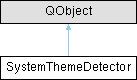
Classes | |
| struct | Impl |
Public Types | |
| enum class | Scheme { Unknown , Light , Dark , Invalid } |
Signals | |
| void | schemeChanged (Scheme scheme) |
Public Member Functions | |
| SystemThemeDetector (QObject *parent=nullptr) | |
| Scheme | currentScheme () const |
Static Public Member Functions | |
| static bool | calibrateDefaultIsDark () |
| static Scheme | resolveDefault (Scheme s, bool defaultIsDark) |
Platform-native detector for the OS-level light/dark preference.
Owned and operated exclusively by ThemeManager. No other component in Wireshark should construct, query, or connect to a detector instance; everything outside the theme subsystem asks ThemeManager::isDark() instead.
The detector begins observing the system setting in its constructor and tears the observer down in its destructor (RAII). There is deliberately no start()/stop() pair.
The actual observation mechanism is platform-specific. A concrete Impl is provided per platform in ui/qt/utils/themes/system_theme_detector_mac.mm (macOS) ui/qt/utils/themes/system_theme_detector_win.cpp (Windows) ui/qt/utils/themes/system_theme_detector_unix.cpp (Linux/BSD) ui/qt/utils/themes/system_theme_detector_stub.cpp (all other builds)
CMake selects exactly one of those for the build.
|
strong |
| Enumerator | |
|---|---|
| Unknown | Internal sentinel for "native query returned no value yet" — every back-end resolves this to a concrete Light or Dark before caching, using the per-system startup calibration of what the desktop's "default"/no-preference scheme renders as. currentScheme() therefore never returns Unknown unless impl_ is null (a degenerate construction failure). |
| Invalid | A particular detection source could not be read, so the next source should be tried. Internal to the platform back-ends; currentScheme() never returns it. |
|
static |
Calibrates "what does this system render the desktop's default/no-preference scheme as?" from the pristine OS palette. Each back-end calls this from its Impl ctor (while the palette is still untouched by any theme override) and stores the result in a defaultIsDark field that resolveDefault() consults.
Defined here so every back-end resolves "default" the same way without each one having to pull in QGuiApplication and ColorMath directly — the implementation lives in system_theme_detector_common.cpp.
| SystemThemeDetector::Scheme SystemThemeDetector::currentScheme | ( | ) | const |
Current OS-level preference, always resolved to Light or Dark. Cached value returned synchronously; safe to call from any thread that can touch the detector.
|
static |
Maps a raw native reading onto a concrete scheme. Unknown becomes Light or Dark according to defaultIsDark (the per-system calibration from calibrateDefaultIsDark()). Light/Dark readings pass through unchanged so explicit OS preferences are honored verbatim.
Used by every back-end so they all collapse the "no preference" case the same way; currentScheme() therefore never surfaces Unknown to callers.
|
signal |
Emitted when the OS preference transitions between Light and Dark. Suppressed for no-op re-reads. Always delivered on the main (GUI) thread.
 1.15.0